One Source of my Dharma
 | |
| One Source of my Dharma Letter to my Children:(#5)
| |

| |
| To read Part-1 please click here One Source of my Dharma (D in DWEL). You ask legitimate questions about this Standard. Is it a rigid set of rules set for ever? Who is its architect and did this just show up one day, or did it evolve over time? In the latter case is it still evolving? Therefore, is the Standard static or a dynamic system? What implications are there for the Hindu (Vedic) survival if the Standard is not upheld? I will try my best to answer some of these questions over time.
Since the gesture of Namaskaar acknowledges the principle of integrated expression of the material body of the other person, one automatically is exhorted to think about expression of the similar molecular events within each individual, and in between that separate and at the same time bind them together. Thus in the ancient tradition of Yoga, the effect of Maxwell's demon is no longer a fantasy or a mere esoteric interpretation of a mathematical equation. The gesture ordains one to acknowledge that the life of the other person is as precious and valuable as that of one’s own. The so called, “Golden rule” ethic of reciprocity- treat others as you would like to be treated - flows right out of the meaning of this simple gesture. This principle is so eloquently and succinctly described by the 15th Century Gujarati poet, Narsi Mehta in his famous poem Vaishnav jan to tene kahiye je PeeD paraayi jaaNe re Par-dukhkhe upkaar kare toye Man abhimaan na aaNe re [One who is a vaishnav( hindu) knows the pain of others; Does good to others, especially to those ones who are in misery, but does not let pride enter his mind]. Here you see the Hindu reverence for and understanding of life that Albert Schweitzer (the 1952 Nobel Peace Prize winner) faulted in his philosophical interpretations. On this earth we humans are constantly tempted to acquire, accumulate and consume. This desire tests one’s mettle of virtue, and can easily draw the person down the path of destruction. The gesture of namaskaar provides a constant reminder of not using means that contravene the identification with the larger Self as the living standard. The acknowledgement of one’s identity with that of the other becomes a virtual deterrent in unscrupulous mechanisms and schemes of material accumulation. This gesture thus signifies the firm ground upon which the individual moral compass is set up to guide one in the journey through life. In a unique and unusual manner the gesture also validates our individual limitation of fulfilling the promise of identifying with the inner self of the other party, and following the Golden rule. Thus you see on the one hand we have Dharma the Standard, and on the other our actions, the Karma that fall short of the Ideal. However, Namaskaar keeps reminding us of the promises to keep no matter the circumstances. However, here I hasten to remind you that the first duty of every individual is self preservation, since without that everything else ceases to exist. Thus the path laid down by the Bhagavat Gita to uphold the Dharma has to be in consonance with preservation of the self as personified by the life example of Lord Krishna and that of Lord Rama. Hence although the simple gesture of namaskaar gives us an understanding of our identity with a global dimension and is one source of my Dharma, its message is tempered with the concept of self preservation challenged by pressures of everyday life. | |

| |
| |
|
| |
| Copyrights © 2007 Shehjar online and KashmirGroup.com .Any content, including but not limited to text, software, music, sound,photographs, video, graphics or other material contained may not bemodified, copied, reproduced, republished, uploaded, posted, ordistributed in any form or context without written permission. Terms & Conditions. | |

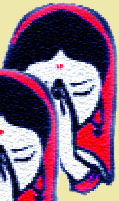 As far as I am concerned one of the sources of my Dharma is in the meaning of the simple Hindu greeting of Namaskaar. You greet people with folded hands in humility. This gesture contains in itself all the commandments that humans have and will ever evolve and put to writing, and try to expound. This gesture has come down to us from time immemorial, used by the ancient Rishis, and the authors of the Vedas and the epics. We use the gesture and its oral expression to address each other, the elders, young ones and God all the same. It tells us that on the inside we are nothing less than the Universal principle we call Brahman. The expression of this gesture assumes the basic understanding of unity in duality at the material and spiritual level. At the material level our body is a combination of chemicals from this earth with a unique integration of their activity at the molecular level that brings forth the complexity of traits and attributes- both physical and psychological. At the spiritual level, Hindus ascribe the unique integrated expression of the molecular events a name-the Atma. The Hindu of Vedic tradition has long ago recognized the universality of that molecular dance in each and every particle of this universe. The gesture thus enjoins reverence for the non-living as well. Since Hindus see every article in this universe as a representation of the Infinite, it only is befitting that no distinctions are made. That is why the Kashmiri Pundit poet Govind Joo Bhan of Wanpoh (a contemporary of Gobind Ji Koul of Wanpoh) said’ Shivanath yiye diye shakti paath varasiye, Zwar chali, zarra maeli seet zarra zarra syi,” [ Arrival of Shiva will bestow Grace, Break my fever; Me the individual particle will mingle-in with the Universal”].