shehjar logo
RECENT UPDATE Promoting Kashmiri Hindu issues of this decade and bring the diverse needs of the community in a format that is easy to read and navigate.
translate image
MORE
CURRENT ISSUE
  • ARCHIVES
    • Archives
    • Articles By Author Name
    • About Archives
  • ABOUT US
    • Join our Team - Write for Shehjar
    • Shehjar
    • About Us
    • Author List
ARTICLE LIST MOST EMAILED MOST VISITED EDITOR'S CHOICE

Shri Chakreshwara and Saundarya Lahiri Post your comments

Valid.
Please fill out this field.
Valid.
Please fill out this field.
Valid.
Please fill out this field.
Valid.
Please fill out this field.
Valid.
Please fill out this field.
Shri Chakreshwara and Saundarya Lahiri Mail to Friend
Your Details
Valid.
Please fill out this field.
Valid.
Please fill out this field.
Valid.
Please fill out this field.
Email To
Valid.
Please fill out this field.
Valid.
Please fill out this field.
Valid.
Please fill out this field.
Valid.
Please fill out this field.

Shri Chakreshwara and Saundarya Lahiri

  • About Author
  • Back To List
  • Email
  • Post Comment
Shri Chakreshwara and Saundarya Lahiri

*
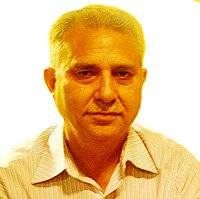
Dr Chaman Lal Raina
The Saundarya Lahiri is the poetic expression of the Shri Chakra. It touches every level of existence and evolution in the inner recesses of one's heart, who understands the beauty of Divine. Always that nameless is given he name of Matri mayi Devi, Amba, Ambhka, etc. to the Divine Mother, the very source of all the Devatas.

The Saundarya Lahiri is the magnum-opus about the Shakti-- tradition of Indian spiritual philosophy, authored by Adi-Shankara, the great Commentator of the Brahma Sutra. Saundarya Lahiri is the synthesis of Kashmir Agamas and the Southern thought of the Divine mother, revered as Shri Lalita. A realization about the ‘Motherhood of God’ is vivid in the Saundarya-Lahiri. Absolute is not abstract alone, it is both static and dynamic. It is ‘Poorna’- the complete and whole. The word 'Saundarya' means aesthetic and Lahiri means wavelet. Therefore, the word Saundarya Lahiri means---- Wavelets of the Divine Beauty.

The Divine mother with thousands of epithets,is complete and whole.The ‘Poorna’ is the attribute of the Mother-creatrix which resembles the full moon in the manifest cosmos, as adored in the Lalita Sahsranama. She is PoorNaand PoorNeshvari. The ‘Poorna’ is be adored, seen and understood is its full bloom. That is why the ‘Poorna-Prakrti’ is adored in the Shakta Sahsranamas of Kashmir as well.

Through POORNA-AHUTI, at the conclusion of the Homas/Yajnas, the mighty self of the cosmic act and adoration is considered to be done,for that event. it falls silent,but not asleep. It iswakeful and receptive to the vibrations of the higher and wider consciousness.

Poorna Ahuti is the essence of the Shakti Sahsranamas. That is why, ATHI -PHOL is shared by children, young and old, men , women, Brahmana and Yajmana all alike to show the oneness of the universal spirit within. Agni is the living consciousness in an Agnihotra.It is the living moment of mutual ascent of the man and descent of the Divine.

ATHI PHOL is purely Kashmiri concept. A clear view is seen in the Bhawani, Shri Ragnya, Shri Jwala, Shri Tripura- Sundari Sahsranamas of Kashmir. Tripura-Sundari is the central nerve of the Divine force of the manifestation in purest form of beauty in existence and in transcendence.

PARAM SUNDARYAI SHRI RAAGNYAI NAMAH and
SHRI BAALA TRIPURA SUNDARYAI NAMAH, ------------

are the sacred adorations to the Divine Mother, evolved by our great saints of Kashmir.

Adi Shankara has developed this ‘Lahiri- Wavelet’ in the aesthetic form to be adored by the devotees, after visiting Kashmir. Saundarya is apparent in manifestiation but hidden in the Yoga. Many translations and commentaries have been written and authored by the devotees, till this date on this wonderful devotional text of Adi Shankara. It has great appeal in the minds of the Shakta devotees. Fine expressions of adorations are found in this sacred text. The Murti of Devis have been inflienced by the Saundarya Lahiri, and the art work related to spirituality isalso seen to be influenced by the miniature and other paintings of Kashmir. Kashmir has been gifted with the Saints and Sages, Yogis and poets, philosophers and literary critics but the central theme of all such works is in the recognition of Self- known as the Pratybignya of the Kashmir Trika Philosophy.

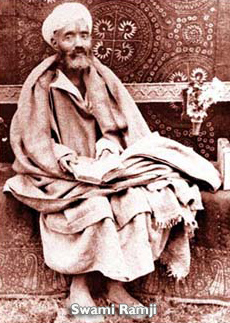
Swami Ram Ji the Great Shaiva Acharya, would teach the Saundarya Lahiri and the Panchastavi in his Ashram at Fateh Kadal, known as the Trika Ashram of Kashmir.The hidden centresof celestial force open like divine flames to reach to the heavenly spheres,while listening to the mystic experience of that great saint of Kashmir. Saundarya Lahiri teaches the beauty of Shri Chakra , through the Oneness of Shiva and Shakti.

Shiva is transcendent, while Shakti is apparent in the form of physical existence. The higher realization sees the ‘Beauty Par-excellence’ in the benign face of the 'Divine mother’. Therefore, Markandeya Rishi visualized the Divine Mother, in the womanhood, and prayed:---

" Vidya Samasta Tavadevi bhedah
Striyaa Samasta Sakala Jagatsu
Tvayi ekaya puritam abbayetad
Kaa teStuti stavya paraparokti'’
------ (Durga Sapteshati Chapter 11 Shloka 6)

O Devi! All the branches of knowledge are your aspects,so are all women in the world.O Ambika--the universal Mother,by You alone this universe is enveloped by Thine grace! What praise thus can be for you in the nature of being of Para Vak --the transcendental speech and beyond the words of Stuti/ laudation.

Shri Chakra is Shri YANTRA

We are blessed that we have the SVAYAMBHU CHAKRESHWAR at the Hari Parbat.

The Shloka reads as ;
SHRI SHAARIKAY SHARANYE TVAAM
MAYI DAASE KRIPAAM KURU---
RINAM ROGAM BHAYAM SHOKAM
RIPU NAASHAYA SATVARAM.

The translation runs as:
O Divine Mother Sharika! I take refuge under you. Do please bless me through your grace. Make me free of all the debts,of all the ailments,sorrow and grief,and save us from enemies. (These enemies are Kama/abuse of physical indriyas, Krodha/ anger, Lobha/greed, Moha/delusion having grown through false ego,while falling in the wrong path of Avidya)

In the Upanishadic and Puranic theology, natural forces were divinised to help man understand the Immutable -- the primal source of creation, preservation and dissolution of the universe. This provided a psychic opening for a vision of the unity of man, God and universe. The Vedic gods are cosmological in character and represent man's aspiration to be in tune with the divine. Agni, Vayu, Ashvinis, Surya, Mitra, Varuna, Shri, Bhu, Prithvi etc.of the ancient Vedic texts are gods who represent various moods and modes of nature and play definite roles in the cosmic drama to keep the rhythm of the universe vibrant. And, it is this rythem that is represented by Mandals and Chakras referred to as 'zageshwar' in Kashmiri religious terminology.It isthe union of Yogi and Yoginis within the Chakreshwara

(Zageshwara is the Apbramsha of Jagriteshwara--the living presence of the Divine)

Seers attributed names and forms to these cosmic forces, and gave them specific traits as aspects of divinity through concepts. They visualized them through the concepts of Bindu or the dot, Trikona or the triangle, Vritta or the circle, Bhupura or the doorway, Padma --the lotus petals or the Kundalini symbols representing Shiva-Shakti. The different devtas and devis, male and female deities, were allotted their Vahanas or the vehicles in the form of animals and birds giving definite meanings to their symbology.

Thus Surya, the sun god, has his celestial chariot drawn by seven horses, each horse symbolizing a definite ray. In the same manner Dwadasha adityas are symbolic of the twelve months of the year. 'Aditya' means the son of Aditi -- the universal energy. She represents the prakriti aspect or the 'nature mother', while Akash is termed as the 'father sky'. The Surya Mandala drawn and worshiped by Kashmiri Pandit ladies on Ashadha Shukla Saptami reminds of the hoary past when the Vedic deity was worshipped in the compounds and kitchens in Kashmiri homes and offerings of rice were placed on the Mandala or the circular drawing representing the cosmic world .

The Sapta Rishis: Vashistha, Kashyapa, Atri, Jamadagni, Gautama, Vishwamitra and Bhardwaja too are symbolic, each representing the cosmic principle in one or other form. While Kashyapa, the progenitor, represents temporal existence, Bhardwaja and Jamadagni symbolises lustre and Kundalini symbolises the vital breath.

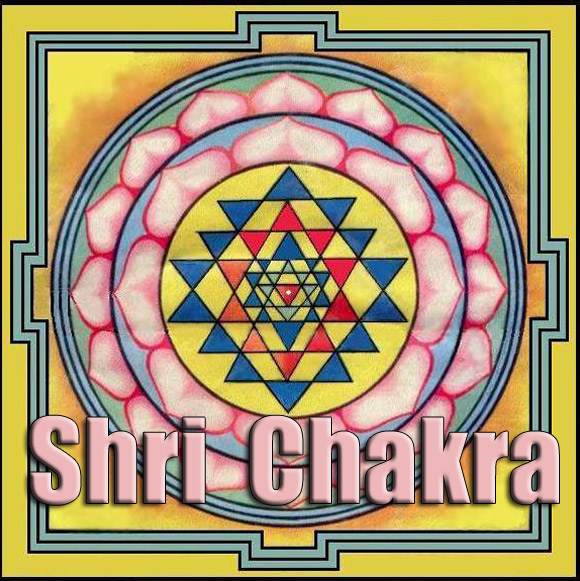
Shri Chakra is the most sacred symbol in the Kashmiri Shakta tradition. The Mool trikona or the central triangle of the diagram is the Yoni with lajjabija and Hrim is its symbol. The triangle is equilateral and its point of concurrence is Bindu -- the absolute reality without any dimension. Its symbolic meaning is made explicit in the following shloka:

Shri Chakra priya bindu tarpana para Shri Rajrajeshwari

Shri Chakra happens to be the Priya bindu, eternally pleasing Shiva absorbing in it s mystic diagram. Shri Rajrajeshwari, the supreme sovereign mother creatrix who is Tarpana para is transcendental in pleasing nature. Bindu represents the dot of our consciousness which gets materialized through Saguna-sadhana of Shri Sharika manifest in the Chakreshwara. The lines of this are the 'wave beats' of the divine and every triangle, lotus petal and circle is the abode of Varnamala (the alphabet) or Matrikas. Matrikas are worshipped at the time of jatakarma, devaguna and Shakta rituals related to homas of Shri Jwala, Sharika, Rajnya, Bala, Bhadrakali and Tripura Sundari.

Shri Chakra is a diagram signifying hope and aspiration. According to those who practice Shakti puja, Shri Chakra symbolises the "One by whom all devatas live." Infinite rays of light emanating from the chakra are received by devotees who worship it with the Kadi mantra of fifteen syllables where the 'bindu' represents the immortal face of Shri Sharika -- the Mother of all bija mantras.

A sound is heard. Timelessness is experienced. The spirit feels the pulsation of the Divine Mother's presence. Each Matrika thinks of its own will,where the cyclic path makes the Mantra manifest in the Navarna/nine syllabled of Shri Chandi, and Panchadashakshari/fifteen syllabled of Shri TripuraSundari or Shodashi of the Bala Tripura.

Kashmiri Pandits used to worship the Shri Chakra on meru made of crystal in their Thakurdwaras or puja rooms which would be situated generally in the Madhya koshtha or the second storey of their homes in accordance with Vastukala/ architecture and Shakti Siddhanta or the principles of Shakti worship. Some used to worship it on a properly engraved copper plate and some on bhoj patra or the birch-bark leaf.

Worshipping Shri Chakra is an essential religious practice of the Kashmiri Pandits. This Maha Mantra used to be read by the devotees, while doing Parikrama of the CHAKRESHWARA.

*Dr. Chaman Lal Raina
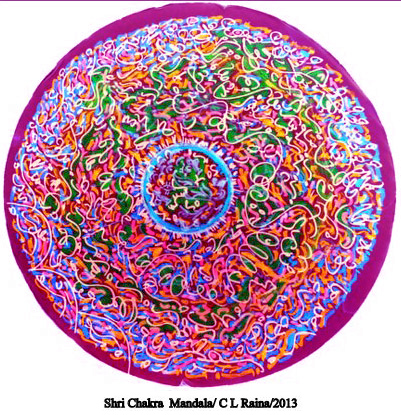
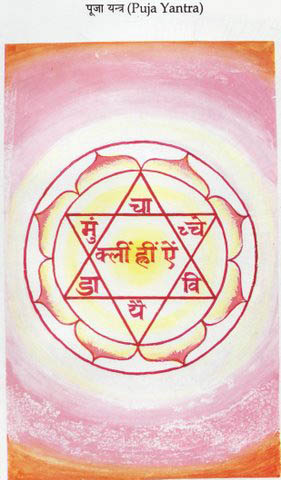
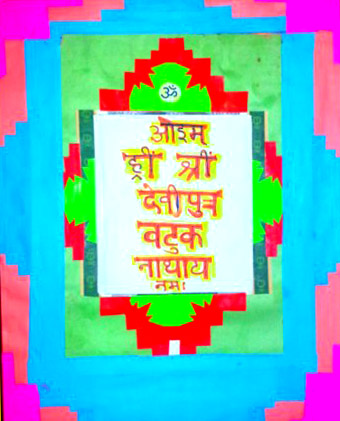
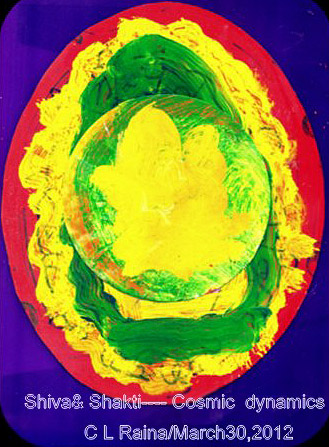
(Paintings by Chaman Lal Raina)
Copyrights © 2007 Shehjar online and KashmirGroup.com. Any content, including but not limited to text, software, music, sound, photographs, video, graphics or other material contained may not be modified, copied, reproduced, republished, uploaded, posted, or distributed in any form or context without written permission. Terms & Conditions.

The views expressed are solely the author's and not necessarily the views of Shehjar or its owners. Content and posts from such authors are provided "AS IS", with no warranties, and confer no rights. The material and information provided iare for general information only and should not, in any respect, be relied on as professional advice. Neither Shehjar.kashmirgroup.com nor kashmirgroup.com represent or endorse the accuracy or reliability of any advice, opinion, statement, or other information displayed, uploaded, or distributed through the Service by any user, information provider or any other person or entity. You acknowledge that any reliance upon any such opinion, advice, statement, memorandum, or information shall be at your sole risk.

  • About Author
  • Back To List
  • Email
  • Post Comment


Comments

It needs a Hindi translation,as well

Added By Abhinav Raina

Our Latest Tweets

Tweets by @shehjarkg

Youth Spotlight

...
Tanya Dhar

Hong Kong national Rugby team Read more

...
Kashmiri Millennials: Rise and Shine

But there is hope – and it begins with us. We can create a world of oneness and belonging – where we connect as mass-miracles of seven exoduses’ in the history of Kashmir. Read more

...
Rudrika Kaul

8 year old Rudrika holds many records in bharatnatayam Read more

...
Anuradha Tikku

A versatile Vocalist Read more

...
The Game Changer: Praneet Bhat

In conversation with Ruchi Kak Read more

...
India's most versatile RJ: Abhimanyu Kak

A singer, composer and actor with his roots firmly grounded in Radio; Abhimanyu, is one of the leading Radio Jockeys in North India Read more

Newsletter Sign Up

First Name This field is required.
Last Name This field is required.
Email         This field is required.

Tags

Kashmir Temple Authors Recipe
facebook facebook twitter
Copyright ©2026 Shehjar.com Powered by Webcontentor